Showing posts with label February 15. Show all posts

The Lupercalia Ancient Festival

Lupercalia was a very ancient, possibly pre-Roman pastoral annual festival, observed in the city of Rome on February 15, to avert evil spirits and purify the city, releasing health and fertility. Lupercalia was also called "dies Februatus", purified (literally "februated day") after the instruments of purification called "februa", which give the month of February (Februarius) its name.

Sacrifice

At the Lupercal altar, a male goat (or goats) and a dog were sacrificed by one or another of the Luperci, under the supervision of the Flamen dialis, Jupiter's chief priest. An offering was also made of salted mealcakes, prepared by the Vestal Virgins. After the blood sacrifice, two Luperci approached the altar. Their foreheads were anointed with blood from the sacrificial knife, then wiped clean with wool soaked in milk, after which they were expected to smile and/or laugh.
The sacrificial feast followed, after which the Luperci cut thongs (known as februa) from the flayed skin of the victim, and ran with these, naked or near-naked, along the old Palatine boundary, in an anticlockwise direction around the hill. In Plutarch's description of the Lupercalia, written during the early Empire,
...many of the noble youths and of the magistrates run up and down through the city naked, for sport and laughter striking those they meet with shaggy thongs. And many women of rank also purposely get in their way, and like children at school present their hands to be struck, believing that the pregnant will thus be helped in delivery, and the barren to pregnancy.
The Luperci completed their circuit of the Palatine, then returned to the Lupercal cave.

Locations
The rites were confined to the Lupercal cave, the Palatine Hill, and the Forum, all of which were central locations in Rome's foundation myth Near the cave stood a sanctuary of Rumina, goddess of breastfeeding; and the wild fig-tree (Ficus Ruminalis) to which Romulus and Remus were brought by the divine intervention of the river-god Tiberinus; some Roman sources name the wild fig tree caprificus, literally "goat fig". Like the cultivated fig, its fruit is pendulous, and the tree exudes a milky sap if cut, which makes it a good candidate for a cult of breastfeeding.

Priesthoods

The Lupercalia had its own priesthood, the Luperci ("brothers of the wolf"), whose institution and rites were attributed either to the Arcadian culture-hero Evander, or to Romulus and Remus, erstwhile shepherds who had each established a group of followers. The Luperci were young men (iuvenes), usually between the ages of 20 and 40. They formed two religious collegia (associations) based on ancestry; the Quinctiliani (named after gens Quinctia) and the Fabiani (named after gens Fabia). Each college was headed by a magister. In 44 BC, a third college, the Juliani, was instituted in honor of Julius Caesar; its first magister was Mark Antony. The college of Juliiani disbanded or lapsed during Caesar's civil wars, and was not re-established in the reforms of his successor, Augustus. In the Imperial era, membership of the two traditional collegia was opened to iuvenes of equestrianstatus.

History
The Februa was ancient and possibly Sabine. After the month of February was added to the Roman calendar, Februa occurred on its fifteenth day (a.d. XV Kal. Mart.). Of its various rituals, the most important came to be those of the Lupercalia. The Romans themselves attributed the instigation of the Lupercalia to Evander, a culture hero from Arcadia who was credited with bringing the Olympic pantheon, Greek laws and alphabet to Italy, where he founded the city of Pallantium on the future site of Rome, 60 years before the Trojan War.
....................................................................................................................
..............................................................................................................................

Christian Feast Days for February 15

Christian feast day:
February 15

  • Blessed Michał Sopoćko
  • Claude de la Colombière
  • Faustinus and Jovita
  • Quinidius
  • Sigfrid of Sweden
  • Thomas Bray (Episcopal Church)

Definition: The calendar of saints is a traditional Christian method of organizing a liturgical year by associating each day with one or more saints and referring to the day as the feast day or feast of said saint. The word "feast" in this context does not mean "a large meal, typically a celebratory one", but instead "an annual religious celebration, a day dedicated to a particular saint".
...........................................................................................................................................................
  • Blessed Michał Sopoćko
He was born in 1888 in Juszewszczyzna (also known as Nowosady) near Valozhyn in present-day Belarus. He entered Vilnius Priest Seminary in 1910 and was ordained in 1914. He was a priest in Vilnius (1914–1918), then a chaplain in the army in Warsaw and Vilnius during World War I. After obtaining his doctorate in theology in 1926 he became the spiritual director at the seminary in Vilnius. and 1928 professor of pastoral theology at Stefan Batory University in Vilnius.


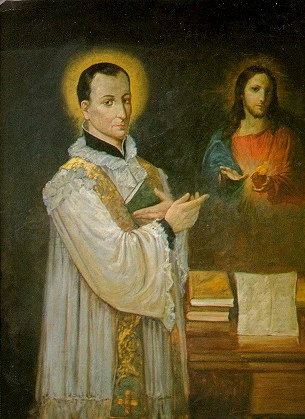
  • Claude de la Colombière
In 1676 Colombière was sent to England as preacher to Mary of Modena, then the Duchess of York, wife of the future King James II of England. He took up residence at the Court of St. James, where he still observed all his religious duties as a member of the Society. He was also as active a preacher and confessor in England as he had been in France. Although encountering many difficulties, he was able to guide Alacoque by letter.


  • Faustinus and Jovita
Their common feast day on 15 February, the traditional date of their martyrdom, was inserted into the General Roman Calendar . It was removed in 1969, because their "Acts are completely fabulous, treating Jovita as a preacher, although she was a woman and a man was Faustinus." However modern minds tend to forget that the name Jovita or Giovita was a man's name in the pre-Christian and early Christian era. Savio highlights that the saints are not to be identified with the fabulous figures in the Acts. The two saints remain listed in the Roman Martyrology, the official, through professedly incomplete, list of the saints recognized by the Catholic Church. The cities of RomeBologna and Verona share with Brescia possession of their relics.


  • Quinidius
(died February 15 c. 579) was a French hermit, deacon, and bishop, who acquired the reputation of being a saint. He was born at Vaison-la-Romaine to a noble Christian family. As a young man, he became a hermit near Toulon and then at Lérins Abbey to devote himself to a life of prayer and asceticism.


  • Sigfrid of Sweden
(born unknown date in Glastonbury, England – 1045 in Växjö) was a Benedictinemonk, bishop in Sweden and saint. He converted king Olof Skötkonung in 1008. His feast day is 15 February.
Sigefride ordained two bishops, the one of East, the other of West Gothland, or Lingkoping, and Scara. The see of Wexiow he continued himself to govern so long as he lived. His three nephews, Unaman a priest, and Sunaman and Wiaman, the one a deacon, the other a subdeacon, were his chief assistants in his apostolic labours.


  • Thomas Bray (Episcopal Church)
(1656 or 1658 – 15 February 1730) was an English clergyman and abolitionist who helped formally establish the Church of England in Maryland, as well as the Society for the Propagation of Christian Knowledge and Society for the Propagation of the Gospel in Foreign Parts.

Thomas Bray was born in Marton, then in the parish of Chirbury, Shropshire, at a house today called Bray's Tenement (now owned by the Nicholls family), on Marton Crest, in 1656 or 1658. He was educated at Oswestry School and Oxford University, where he earned a B.A. degree with All Souls College in 1678 and a M.A. with Hart Hall in 1693. He also completed the work for B.D. and D.D. degrees at Oxford (Magdalen, 17 Dec. 1696) at the request of Maryland's governor, but was unable to pay the required fees.
........................................................................................................................................