Showing posts with label November food holidays. Show all posts

Todays Holiday is Chitlin Strut

The Chitlin' Strut is a feast of chitlins, or chitterlings (hog intestines), held in the small town of Salley, South Carolina. 

The affair features a "hawg-calling" contest, country music, arts and crafts, a parade, lots of chitlins (about 8,000 pounds are devoured each year), and chicken for those not enamored of chitlins. Chitlins are prepared by cleaning them well, boiling them until they are tender, and then, after coating them in egg and crumbs, frying them in deep fat until they're crackling crisp.

Salley was named for Col. Dempsey Hammond Salley, who donated the site in the 19th century.
The Chitlin' Strut began in 1966 to raise money for the town's Christmas decorations. The Strut now draws as many as 50,000 people, and Salley, with a population of 700, has used the revenues from it to pay for such necessities as trash cans,signs, and even a fire truck.

...................................................................................

What is a chitlin?

Chitterlings sometimes spelled/pronounced chitlins or chittlins) are a prepared food usually made from the small intestines of a pig, although the intestines of cattle and other animals are sometimes used.
..................................................................................

In the United States 

chitterlings are part of the Southern United States culinary tradition commonly called "soul food".
Chitterlings are carefully cleaned and rinsed several times before they are boiled or stewed for several hours. A common practice is to place a halved onion in the pot to mitigate the very unpleasant odor that can be particularly strong when the chitterlings begin to cook. Chitterlings sometimes are battered and fried after the stewing process and commonly are served with apple cider vinegar and hot sauce as condiments.
When slavery was legal in America, slave owners commonly fed their slaves as cheaply as possible. At hog butchering time, the best cuts of meat were kept for the master's household and the remainder, such as fatback, snouts, ears, neck bones, feet, and intestines, were given to the slaves. (website)
In 2003, the Smithsonian Institution's Anacostia Museum and Center for African American History and Culture accepted the papers of Shauna Anderson and her business, The Chitlin Market, as part of its emerging collection of materials about African American celebrations, foods and foodways.

............................................................................................

Resources:

  • Holidays, Festivals, and Celebrations of the World Dictionary, Fourth Edition. S.v. "Chitlin' Strut." Retrieved November 24 2018 from Go to freedictionary for contact information
  • www.gone-ta-pott.com
  • wikipedia.org
...................................................................................


November 24 is National Sardines Day

Happy National Sardines Day everyone!
When is this celebrated?
National Sardines Day is celebrated every November 24th each year.
Who celebrates this holiday?
Everyone who loves sardines!
How is this holiday celebrated?
by searching out yummy ways of eating sardines and introducing them to friends and family.
......................................................................................................

Sardines? What are they?
Sardines are a nutrient-rich, small, oily fish widely consumed by humans and as forage fish for larger fish species, seabirds and marine mammals. It is a source of omega-3 fatty acids. They are commonly served in cans, but fresh sardines are often grilled, pickled, or smoked.

Sardines, are related to 
herrings, family Clupeidae. The term sardine was first used in English during the early 15th century, and may come from the Mediterranean island of Sardinia, around which sardines were once abundant.

Sardines are commercially fished for a variety of uses: 
for bait; for immediate consumption; for canning, drying, salting, or smoking; and for reduction into fish meal or oil. The chief use of sardines is for human consumption, but fish meal is used as animal feed, while sardine oil has many uses, including the manufacture of paint, varnish, and linoleum.
........................................................................................................................................
Nutrition:
Sardines are rich in vitamins and minerals. A small serving of sardines once a day can provide up to 13% of the RDA (recommended daily allowance) value of vitamin B2, roughly one-quarter of the RDA of niacin, and about 150% of the RDA of vitamin B12. All B vitamins help to support proper nervous system function and are used for energy metabolism, or converting food into energy. Also, sardines are high in the major minerals such as phosphorus, calcium, potassium, and some trace minerals such as iron and selenium. Sardines are also a natural source of marine omega-3 fatty acids, which reduce the occurrence of cardiovascular disease. Recent studies suggest the regular consumption of omega-3 fatty acids reduces the likelihood of developing Alzheimer's disease and can even boost brain function. These fatty acids may also help lower blood sugar levels a small amount.They are also a good source of vitamin D, calcium, and protein.
Because they are low in the food chain, sardines are very low in contaminants, such as mercury, relative to other fish commonly eaten by humans.
.................................................................................................................
Resources:
..............................................................................................................

National Peanut Butter Fudge Day

Happy National Peanut Butter Fudge Day!

Fond Memories
I sure love peanut butter fudge. My Mother use to make the most delicious peanut butter fudge you ever put in your mouth. As hard as I tried, I could never make it like she did..... but thank goodness she taught my brother how to do it and he can make it just like she did. I wonder if he is making any today in celebration of Peanut Butter Fudge Day?


Fudge is a type of sugar candy that is made by mixing sugar, butter and milk, heating it to the soft-ball stage at 240 °F (116 °C), and then beating the mixture while it cools so that it acquires a smooth, creamy consistency. Fruits, nuts, chocolate, caramel, candies, sweets and other flavours are sometimes added either inside or on top. A recent trend has been to create novel flavours of fudge, giving vibrant visual appeal at the same time.
Fudge is often bought as a gift from a gift shop in tourist areas and attractions.
.....................................................................................................

Date:
National Peanut Butter Fudge Day is celebrated every November 20th.

Who Celebrates it?
Everyone who loves peanut butter fudge. Especially those in the United States.

How is this holiday celebrated?

  • By making homemade peanut butter fudge
  • By sharing peanut butter fudge
  • By going to your favorite bakery and treating yourself to your favorite. Do you eat it with or without whole peanuts?
..................................................................................................................

Resources:
................................................................................................................

Month long food observances for the month of November

Chocolate Fondue made with the fruit brandy kirschwasser

Slices of fruit or pastry are dipped in a caquelon of melted chocolate, often flavored with rum or kirschwasser.  

This recipe is made with Kirschwasser a clear, colorless fruit brandy traditionally made from double distillation of morello cherries, a dark-colored cultivar of the sour cherry 


Dessert fondues may also be made with coconut, honey, caramel, or marshmallow. 

......................................................................................................

RECIPE
  • 6 ounces of milk chocolate (chips or roughly chopped from a block)
  • 6 ounces of dark chocolate (chips or roughly chopped from a block)
  • 1 cup (8 ounces) of heavy whipping cream
  • 1 tablespoon butter
  • A pinch of salt
  • 3 tablespoons Kirschwasser
  1. Melt both chocolate together in a double bowler with butter.
  2. Heat cream on medium heat in a separate pan with pinch of salt.
  3. Remove cream from heat / add the chocolate and mix until smooth.
  4. Add kirschwasser in last / stir until blended
  5. pore in fondue pot
  6. If fondue becomes to thick / just add a tablespoon of cream and stir.

You can also add a flavorful touch by adding either
  • cinnamon
  • flavored irish creams
  • peppermints
  • pinch of cayenne pepper

Dip with: 
  • cubed pound cake
  • sponge cake
  • angel food cake
  • strawberries
  • sliced bananas
  • apples
  • cookies
  • lady fingers
  • dried appricots
..............................................................................................................................

This post is in honor of 
"Fun with Fondue Month" which is celebrated the whole month of November.
...............................................................................................................................

National Mousse Day is celebrated every November 30

I do love chocolate and I do love ice cold chocolate mousse. So In honor of National Mousse Day, I'm going to blog about mousse and pass on a mousse recipe.

Mousse is derived from the French word mousse which means "lather" or "foam". A mousse is a prepared food that incorporates air bubbles to give it a light and airy texture. It can range from light and fluffy to creamy and thick, depending on preparation techniques.

Dessert mousse

A dessert mousse is a form of dessert typically made from egg and cream (classically no cream, separated eggs, sugar, and chocolate or other flavorings), usually in combination with other flavors such as chocolate or pureed fruit. Once only a specialty of French restaurants, chocolate mousse entered into American and British home cuisine in the 1960's.
Mousse au chocolat (French for "chocolate foam") is a sweet food, normally served as dessert.

Ingredients

  • 200 g (8 oz) bittersweet chocolate, chopped (see Note)
  • 3 eggs (see Note)
  • 250ml (1 cup) cream
  • 40g sugar
  • 30 ml (2 tablespoons) hot water

Procedure

  1. Melt the chocolate in a double boiler.
  2. Separate the eggs.
  3. Whisk the egg whites and cream separately until very firm. Put both in the refrigerator.
  4. Combine the egg yolks and hot water in a mixing bowl (maximum tap water temperature is enough, approx. 50°-60°C or 120°-140°F). Using a mixer, beat slowly while adding the sugar, then speed up the mixer until the mixture is thick and becomes a light yellow color.
  5. Stir the melted chocolate into the yolk mixture (the chocolate should have cooled enough that it does not hurt if you insert your finger). Mix immediately, otherwise this will cook the egg yolks, and you'll have chocolate scrambled eggs!
  6. With the whisk (from now on do not use the mixer) add the egg whites in three parts to the chocolate mixture, followed by the whipped cream.
  7. The finished mousse should be light brown and very fluffy. While it is still liquid, divide it into individual serving dishes. Allow to chill in the refrigerator for 4-6 hours before serving. The mousse will be quite firm when ready.

Notes, tips and variations

  • This recipe is not the "purest" form, which contains only bittersweet chocolate and eggs: 6 eggs for 200 g (8 oz) of chocolate; no cream, no sugar.
  • It is one of the easiest recipes for untrained cooks. The only "difficult" parts are separating the eggs and folding the egg whites.
  • For the more advanced cook: use a fourth yolk (and only the yolk!); it ensures that the mousse becomes firm. However, the mixture must be worked faster, beginning with the addition of the chocolate to the yolk/sugar mixture.
  • Instead of the water, use an alcoholic spirit such as Cognac, Cointreau, Kahlua, Triple Sec, etc., for all or part of the 30 ml. However, the mousse is then not suitable for children or pregnant women.
  • Coffee can also be satisfyingly substituted for the liquid.
  • Almond powder, almond butter, or orange rind can also be used to add flavor to the mousse (one tablespoon per 6 eggs)
  • There is also an Atkins-friendly recipe.

Warnings

  • This mousse is best consumed within 24 hours.
  • Do not keep substantially longer, even if refrigerated.
 Photo Source: imgfave.com via Alex on Pinterest / Article source: wikibooks

Outside Links:
--------------------------------------------------------------------------------------------------------------------
*See Janet's chocolate-mousse-round-up! She loves mousse! 

Food for a Pickle Appreciation Party

For those of you looking for a weird theme party, we have an idea for you. November 14 is Pickle Appreciation Day and today one of our readers asked the question.... "What food can I serve for a Pickle Appreciation Party?" Well get those green plates and napkins ready because we have a few ideas for you.

With you it's a treat
First of all we think you should serve dishes that relate to pickles. 
The first thing that comes to mind is pickle condiments. The most popular pickle condiment without a dough is pickle relish. What goes with pickle relish you ask? Well it's hot dogs! Yep our first choice would be hot dogs or sausage dogs along with several types of pickle relish guests can choose from.

Tartar Sauce: Tartar Sauce is another condiment that's made with pickles. If fish is for you, then fish sandwiches could be a second choice for a pickle appreciation party and don't hold back on the tartar sauce.

Every party serves cake! Yes every party serves cake and a pickle party wouldn't be complete without a pickle cake. Noooo don't put pickles in the cake mix. Just decorate your cake to look like a giant pickle. Cook a sheet cake and trim the edges to be round and long. Cover in vanilla icing with green food coloring and you have yourself a giant pickle.

Why not have a pickle buffet for taste testing? Yeah! Everyone loves to munch on pickles and having a dozen or so varieties of pickles could be really fun. Have them all, sweet, hot and sour! You could even have your guests judge the best pickles. The good.... the bad.... or the ugly.

Potato Salad: We can't forget about potato salad! Many many potato salad recipes use pickles in the recipe. Some call for sweet pickles and some call for dill pickles.

Speaking of potatoes! Don't forget that potato chips and parties go hand in hand. Having said that, did you know there's a dill flavored potato chip? Yep it sure is! That would go great with hot dogs. :)
If all else fails.... serve all green food.

I hope that get's your creative juices flowing. Now before you go, click on the cute dancing pickles at the top. You'll see it's actually a greeting card for Pickle Appreciation Day. Send it to your friends and invite them to your pickle party. May your Pickle Appreciation Party be a success.  - Pam
See all pickle appreciation greeting

Maybe our readers could join in the fun and post a few pickle dishes too. :)
- - - - - - - - - - - - - - - - - - - - - - - - - - - - - - - - - - - - - - - - - - - - - - - - - - - - - - - - - - -
Shop Amazon for all things pickle
Shop Amazon for pickle party

Pepero Day in South Korea

Pepero Day is an observance in South Korea similar to Valentine's Day. It is named after the Korean snack Pepero and held on November 11, since the date "11/11" resembles four sticks of Pepero.
pepero almond sticks photo by Evan-Amos
What is Pepero? Pepero (빼빼로) is a cookie stick, dipped in chocolate syrup, manufactured by Lotte Confectionery in South Korea since 1983. It was copied from the Japanese product, Pocky produced by Glico.

The holiday is observed mostly by young people and couples, who exchange Pepero sticks, other candies, and romantic gifts. Lotte denies starting the holiday and instead states that they noticed a bump in Pepero sales around November 11th and after continued popularity they decided to then encourage the holiday with special gift boxes and other promotions. Some consider it to be a contrived holiday and some teachers have encouraged children to exchange healthy snacks to help combat obesity. An alternative "Garaetteok Day" (sticks of white tteok) has been proposed.

According to one story, Pepero Day was started in 1994 by students at a girls' middle school in Busan, where they exchanged Pepero sticks as gifts to wish one another to grow "as tall and slender as a Pepero".

As of 2007, it was sold in 10 different flavors:
  • Regular or Chocolate
  • Strawberry-flavored
  • Almond Chocolate
  • Nude (chocolate in the center)
  • Nude Lemon Cheese
  • Cocoa
  • Soft
  • Cheese
  • "Woman in White" and "Man in Black" are slightly more "classy" brands of Pepero, and both have chocolate cookie bits scattered throughout the chocolate dip.
  • Topic, a style similar to Japanese Toppo, also manufactured by Lotte.


In Japan, a similar Pocky Day was started but not as widely celebrated as it is in Korea.
- - - - - - - - - - - - - - - - - - - - - - - - - - - - - - - - - - - - - - - - - - - - - - - - - - - - - - -
resources: Official Pepero Site / wikipedia / gone-ta-pott.com /thefreedictionary.com
links: Pepero HistoryPepero Day sweet for food retailers / Sth Korea calendar laden with love

Pocky Day In Japan


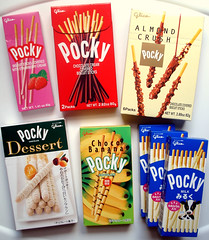
November 11 is Pocky Day in Japan! Most Americans are not familure with this food holiday but since Pocky is gaining more and more followers; Pocky Day is starting to be celebrated in the United States too. Lots of people don't know what Pocky is so here's a good photo of a few flavors. Pocky is a Japanese snack food produced by the Ezaki Glico Company of Japan. And I have to tell you  I buy them every time I see them in America.

Pocky
Originally uploaded by Laura Bento
History
Pocky was first sold in 1966, and consists of a biscuit stick coated with chocolate. It was named after the Japanese onomatopoetic word for the sound Pocky makes when bitten, pokkin (ポッキン). The original was followed by "Almond Pocky" in 1971, with an almond coating, and "Strawberry Pocky" in 1977. Today, the product line includes such variations as milk, mousse, green tea, honey, banana and coconut flavored coatings, and themed products such as "Decorer Pocky," with colorful decorative stripes in the coating, and "Men's Pocky," a dark (bittersweet) chocolate and "mature" version.

World distribution
Pocky is popular in Japan and was a hit among teenagers. In bars it is sometimes served with a glass of ice water. It also has a significant presence in other East Asian countries such as China as well as South Korea (although a similar product known as pepero is one of copy-products by Lotte; not a renamed product of Pocky). In Europe Pocky was renamed Mikado. Mikado can be found at most supermarkets, as well as at many international food stores. In Malaysia Pocky was renamed Rocky to avoid sounding like "pork". The original Pocky-branded versions can still be easily obtained in Malaysia from import stores, usually located within shopping complexes. In the United States and Canada Pocky can be found in Asian supermarkets and the international section of most large supermarkets, such as World Market, HEB, Wegmans, at select f.y.e. stores, Walmart (in the Asian foods aisle), Borders bookstores, some Target stores, some Walgreens, Meijer, and anime convention dealers' rooms. In the United States Pocky is marketed both by LU (in chocolate and peanut butter flavors) and by Ezaki Glico's American division, Ezaki Glico USA Corporation (in chocolate and strawberry flavors). In Australia Pocky is usually sold in Asian convenience markets along with other Asian foods and products.

Flavors and Variations
Pocky can be found in dozens of varieties such as chocolate, strawberry, and almond. Some of the more unusual flavors include the seasonal flavors of honey (spring) and kiwifruit mango (summer). The bittersweet version of chocolate Pocky is known as Men's Pocky. Regional flavors of Pocky include grape (Nagano), yūbari melon (Hokkaidō), giant mikan (tangerine, sold in the Kyūshū region), powdered tea azuki bean (Kyoto), Kobe wine (Kobe), and five-fusion berry (Goka). There are also such flavors as banana, coffee, caramel, marble royal milk tea, melon, milk, honey and milk, cream cheese, berry, sweet potato, coconut, crush (crunchy cracker pieces in chocolate), pineapple, pumpkin, hazelnut, kurogoma (black sesame), kinako (soy bean flour), marron, Brazilian pudding, mikan, blueberry, apple yogurt, mixed berry and green tea.

Special variations of Pocky include Decorer Pocky (which features extra decorative icing) and Mousse Pocky (which features extra thick, "creamy" mousse-like icing and is more exclusive). Unlike other Pocky variations, Mousse Pocky packages contain fewer pieces than regular Pocky, with only nine pieces per pack.

Dessert Pocky features Pocky sticks covered in a generous helping of cream. These flavors include: Double Chocolate, Tiramisu, Chocolate Banana, Marron White, Chestnut, Strawberry Shortcake, and Orange. Dessert Pocky usually comes with five packets in a box with three in each sleeve.

Other variations include: Pocky G (marketed as being "hard and rich"), Giant Pocky (Strawberry and Chocolate flavored; each box contains 20 individually wrapped sticks with real dried strawberry; each stick is about 10" long, and approximately 3 times the diameter of a normal Pocky stick), Reverse Pocky (cracker on the outside with the filling in the middle), Fortune-Telling Pocky (each stick contained a "fortune") and Pocky Cake (a literal cake shaped to look like a Pocky stick. Each cake contained, according to its packaging, raisins, chocolate cream, orange peel, and an Italian cake batter).

A related product is Pretz, which is an unglazed version of Pocky, featuring flavors like tomato, pizza, and salad, as well as sweet flavors such as French toast.
- - - - - - - - - - - - - - - - - - - - - - - - - - - - - - - - - - - - - - - - - - - - - - - - - - - - - - -
resources: official website of pocky / wikipedia / gone-ta-pott.com /thefreedictionary.com
links: how to make your own pocky / original chocolate pocky /

Crullers or Twisters in honor of Doughnut Appreciation Day

Chocolate Cruller Doughnut
November 5 is Doughnut Appreciation Day so I felt I couldn't let this day pass without talking about crullers; one of the most popular holiday donuts/doughnuts known world wide. This doughnut is popular topped in chocolate but I for one love the French crullers without chocolate but dipped in a sugar glaze coating. I will include a recipe in the next post ok.

A cruller, or twister, is a twisted and usually ring-shaped fried pastry. It is traditionally made of dough somewhat like that of a cake doughnut, often topped with plain powdered sugar; powdered sugar mixed with cinnamon; or icing. A French cruller is a fluted, ring-shaped doughnut made from choux pastry with a light airy texture.

Celebration Food: The name comes from early 19th century Dutch kruller, from krullen "to curl". Crullers are traditionally eaten in Germany and some other European countries on Shrove Tuesday, to use up fat before Lent. In Danish they are knowns as "Klejner" and in Swedish as "Klenäter", both names deriving from Low German. In Scandinavia crullers are common at Christmas.

Crullers are most commonly found in Canada, New England and the Mid-Atlantic and North Central states of the USA, but are also common in California. The German origin is probably why traditional crullers can be found more easily in the Midwest, where many German immigrants settled. Some family-owned bakeries still call them "krullers." In other parts of the U.S., crullers may be called "dunking sticks" or simply "sticks."

In 2003, the Dunkin' Donuts chain of doughnut shops stopped carrying traditional crullers, claiming that the hand-shaped treats were too labor-intensive, and couldn't be simulated with new machines for mixing doughnut batter. They still sell "French Crullers." Tim Hortons, Honey Dew Donuts, and Krispy Kreme still sell the Cruller. (wikipedia links)
- - - - - - - - - - - - - - - - - - - - - - - - - - - - - - - - - - - - - - - - - - - - - - - - - - - - - -


Did you know this about Candy and vegetarianism?

A heap of HARIBO gummy bears
This post is in honor of National Candy Day which is celebrated on November 4th every year in the United States. We found a few interesting facts we wanted to share with our candy loving readers.

Some candy, including marshmallows and gummi bears, contain gelatin derived from animal collagen, a protein found in skin and bones, and is thus avoided by vegetarians and vegans. "Kosher gelatin" is also unsuitable for vegetarians and vegans, as it is derived from fish bones. Other substances, such as agar, pectin, starch and gum arabic may also be used as setting and gelling agents, and can be used in place of gelatin.

Other ingredients commonly found in candy that are not suitable for vegetarian or vegan diets include carmine, a red dye made from cochineal beetles, and confectioner's glaze, which may contain wings or other insect parts. wikipedia
- - - - - - - - - - - - - - - - - - - - - - - - - - - - - - - - - - - - - - - - - - - - - - - - - - - - - - - - - - - - - - -
Wow right!?

National Split Pea Soup Week

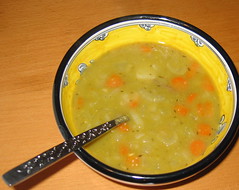
Split Pea Soup (Recipe) Originally uploaded by Ruthieki
The 2nd week in November is National Split Pea Soup week! The great split pea soup photo is by Ruthieki from flickr with recipe.


I know many people love this soup but I didn't grow up eating this soup at all. I know your not going to believe this but I ate this soup for the first time when I was about 40 years old. I found a bag of split peas at the grocery store that had a split pea recipe on the back. Well...... I followed the recipe which seemed pretty plain. It was mainly just peas, dried onions and chicken stock. I let it simmer for about 4 hours and it was ready. I thought to myself... hummm, so this is split pea soup?? The greyish green color was a turn off for me and I have to say the taste of my soup was not much better. hahaha! I later found many other split pea recipes that were a lot more colorful and full of other tasty ingredients like carrots, potatoes, onions, celery etc. Now that's more like it!! Read our Article Soups Not Just for Eating
- - - - - - - - - - - - - - - - - - - - - - - - - - - - - - - - - - - - - - - - - - - - - - - - - - - - - - - - - - - -